
What to Do When Your Child Has Big Emotions (Step-by-Step Guide)

Big emotions can appear suddenly.
One moment your child is calm, and the next they are overwhelmed — crying, angry, or completely shut down. For many parents, this is one of the most difficult situations to handle.
The most important thing to understand is this:
Big emotions are not a behavior problem.
They are a signal.
When a child experiences a strong feeling, their brain reacts faster than they can think. Their body takes over — heart rate increases, tension builds, and words become harder to find. In that moment, your child is not choosing how to react. They simply don’t yet have the tools to manage what they feel.
The goal is not to stop the emotion, but to guide your child through it.
How to Help Your Child Calm Down Without Yelling

Big emotions don’t wait. They come quickly, and when they do, children don’t pause — they react.
The instinct is often to raise your voice to stop the moment and bring things back under control as fast as possible. But for a child, intensity doesn’t calm intensity. It often makes it grow.
The first step is not to fix the situation. It’s to slow it down. Take a moment before responding. Even a few seconds can change the tone of what comes next.
Instead of reacting to the behavior, try to notice the feeling underneath. You might say, simply: “I see this is a lot right now.” Not to solve it, just to acknowledge it.
When a child feels seen, something begins to shift. The emotion doesn’t disappear, but it becomes less overwhelming.
What to Do When Your Child Wants More Independence

At this age, children start wanting to do more on their own. They want to choose, try, and decide without constant help.
The mistake is often to either hold on too tightly or step back too much. What works better is staying involved without taking control.
The first step is to slow down your intervention. When your child starts something, don’t jump in immediately. Wait a few seconds. Let them try, even if it’s not perfect.
If you step in too early, the message becomes:
“You can’t do it without me.”
Instead, stay close and observe before acting.
When help is needed, offer support without taking over:
“Do you want a hint, or do you want to try again first?”
What to Do After You Lose Patience as a Parent

Losing patience happens. What matters is what comes next.
The instinct is often to move on quickly or act like nothing happened. But for a child, the moment doesn’t disappear. It stays, especially if it felt intense or confusing.
The first step is to pause before fixing anything. Take a moment to calm yourself. Trying to repair the situation while still frustrated usually makes it worse.
Once things are calmer, go back to your child and acknowledge what happened—simply and clearly:
“I got frustrated earlier and spoke too strongly. I’m sorry about that.”
This is not about over-explaining or justifying. It’s about showing responsibility.
Avoid turning it into a lesson immediately. Long explanations often shift the focus away from the moment. What helps more is keeping it short and real.
This keeps the child in charge while showing you are available.
What to Do When Your Child Says “You Don’t Understand Me”

At this age, children start experiencing things more deeply than they can explain. When they say, “You don’t understand me,” it’s often less about the situation and more about how alone they feel in that moment.
The instinct is to correct them:
“I do understand.”
But this usually creates more distance, not less.
What helps more is to step out of the need to prove understanding. Instead of answering, shift into listening without trying to fix or clarify right away. The goal is not to be right — it’s to make the child feel heard.
Often, children don’t want a solution. They want space to express something they are still figuring out themselves. If we move too quickly into explanations or advice, it interrupts that process.
What to Do When Children Don’t Listen (Without Repeating Yourself)
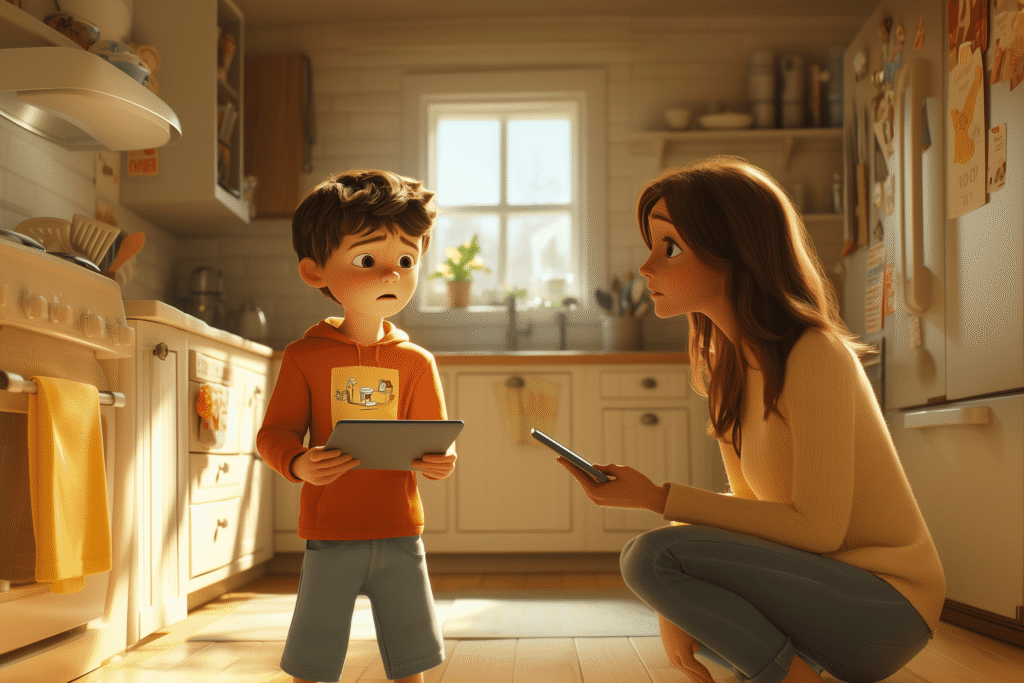
When a child doesn’t listen, repeating instructions usually makes things worse. The more we repeat, the less they respond. What works better is changing how the message is delivered.
The first step is to remove distance. Instead of calling from across the room, move closer. Stand near the child, lower yourself to their level, and make sure you have their attention before speaking.
Then, say the instruction once — and stop. Keep it short and clear:
“Shoes on now.”
Avoid adding explanations or extra words. The message should be easy to follow.
If there is no response, don’t repeat. Shift from talking to guiding. Gently point, hand them the object, or guide the first movement. This helps the child move into action without pressure.
Helping Children Manage Frustration in Everyday Situations (Real-Time Solutions That Work)

Frustration can rise very quickly in children — and when it does, reasoning or long explanations rarely help. In those moments, what works best is not theory, but simple and immediate actions.
The first step is to interrupt the reaction early. As soon as you notice signs of frustration — a change in tone, tension, or refusal — step in with a short, calm phrase like:
“Pause. Stay with me.”
Keep it brief and steady. Long sentences often make the situation worse.
Instead of trying to talk through the emotion, focus on changing the child’s state. A small physical action can reset the moment faster than words. Ask them to stand up, take a sip of water, or move slightly. This helps break the emotional loop.
When frustration comes from difficulty, reduce the challenge immediately. Rather than pushing them to continue alone, say:
“We do it together now.”
This prevents the feeling of failure from growing.
Why Do Children Struggle to Concentrate Today — and How Can We Help Them?

Why does my child lose concentration so quickly?
Many parents notice that their boy or girl begins homework or reading with good intentions, but within a few minutes their attention drifts elsewhere. This is increasingly common. Children today grow up in environments filled with stimulation — screens, sounds, notifications, and constant activity. Young brains are naturally curious, so every new signal can pull their attention away from the task in front of them.
This does not mean a child lacks discipline or ability. In many cases, it simply means their brain is still learning how to manage distractions.
How can parents help children concentrate better?
Small daily habits can make a meaningful difference. Creating a calm and predictable place for homework helps the brain recognize that it is time to focus. Breaking large tasks into shorter segments can also make activities feel more manageable. A child who concentrates for fifteen focused minutes often works more effectively than one who struggles through a long period of frustration.
Encouraging short breaks can also help reset attention and reduce mental fatigue.
Growing up is not about doing everything right — it’s about noticing moments

Growing up today often feels loud. There are endless opinions, expert voices, comparisons, and invisible deadlines. Screens move fast, schedules fill quickly, and even childhood can start to feel like something we’re supposed to optimize. Many parents carry a quiet pressure to keep up, to respond correctly, to make the “right” choices at the right time — even when no one clearly explains what “right” means.
But growing up doesn’t actually happen in big decisions or perfect strategies. It happens in small, ordinary moments that are easy to miss. A question asked in the car. A silence after a difficult day. A laugh that comes back when things slow down. These moments don’t look impressive, and they don’t fit neatly into advice lists — yet they are often the ones children remember and carry with them.
Why Friendships Matter More Than We Think During Childhood

Info Box
Friendships are often seen as a natural and uncomplicated part of childhood. Children meet, play, argue, reconnect, and move on. From the outside, these moments can seem small, but for a child, they carry significant emotional weight.
As parents, it can be difficult to know how involved to be. We may wonder when to step in, when to stay back, and how much guidance is helpful without taking control. Yet friendships are one of the first spaces where children begin to experience independence within relationships.
Through friendships, children explore belonging, difference, acceptance, and rejection. They learn what it feels like to be chosen, to be disappointed, or to feel unsure of their place. These experiences influence how they see themselves and how confident they feel expressing who they are.
Family Is Not About Being Perfect — It’s About Learning How to Care for Each Other

Info Box
Many parents carry a quiet pressure to create a “perfect” family environment — calm mornings, patient conversations, and always saying the right thing. But real family life rarely looks like that, and that’s not a failure. It’s normal.
Family is the first place where children learn how relationships truly work. They learn through everyday moments: misunderstandings, small conflicts, shared routines, and moments of repair. What shapes them most is not perfection, but how family members respond to each other when things are imperfect.
When children see adults apologize, listen, and try again, they learn that mistakes are part of relationships, not the end of them. They learn that care can be shown in many forms — through attention, boundaries, support, and presence, even on difficult days.
The Digital World Is Part of Childhood Now — The Question Is How We Guide It

Info Box
The digital world is no longer separate from childhood — it is part of it. Children communicate, play, learn, and explore online with a confidence that often leaves parents feeling uncertain or outpaced.
While children may appear comfortable with technology, that doesn’t mean they fully understand its emotional, social, or long-term impact. What they often need is not restriction alone, but guidance — calm, informed, and consistent.
Online spaces expose children to ideas, interactions, and expectations far earlier than previous generations experienced. This can influence how they see themselves, how they relate to others, and how they handle pressure or comparison. Without support, these experiences can quietly shape their confidence and behavior.